Types of numbers.
1) Whole numbers 0, 1, 2, 3, 4, 5, ………….
2) Counting numbers/ Natural numbers 1, 2, 3, 4, 5, ………….
3) Odd numbers: These are numbers that give a remainder when divided by 2
{1, 3, 5, 7, ……………….}
4) Even numbers: These are ones that are exactly disable by two
{0, 2, 4, 6, 8, 10, ……………….}
5) Prime numbers: These are numbers with only two factors.
{2, 3, 5, 7, 11, 13, ……………….}
6) Composition numbers: These are numbers with more than 2 factors
{4, 6, 8, 9, 10, 12, ……………….}
7) Square numbers: These are numbers got by multiplying a number by its self.
{1, 4, 9, 16, 25, ……………….}
8) Cubic numbers: These are got by multiplying the same number three times.
{1, 8, 27, 64, ……………….}
9) Triangular numbers: These are got by adding consecutive counting numbers.
{1, 3, 6, 10, 15, 21, ……………….}
+2 +3 +4 +5 +6
MULTIPLES AND L.C.M
Take note of the limits
*Less than
*From to
*between ……………. And ………..
*The first………………..
Examples
{24, 30, 36}
M12 = {12, 24, 36, 48, 60}
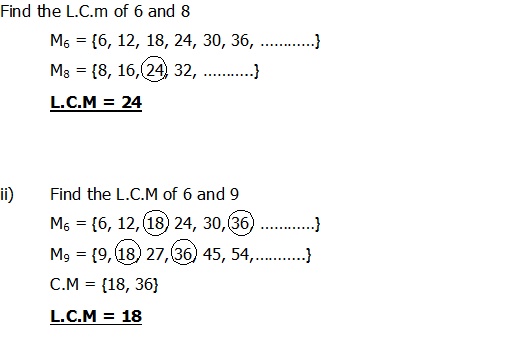
Finding lowest common multiple by listing down multiples
Example
DIVISIBILITY TESTS
These show which number is exactly divisible by another given number.
Divisibility test for 2.
A number is divisible by 2 if the last digit is an even number
i,e 0, 2, 4, 6, 8, …………..
Divisibility test for 3.
A number is divisible by 3 if the sum of its digits is divisible by 3.
Example.
State whether 144 is divisible by 3.
Sum of the digits 1 + 4 + 4
= 9
9 is divisible by 3
144 is divisible by 3.
Divisibility test for 4
A number is divisible by 4 if its last two digits are zero or divisible by 4.
Divisibility test for 5
A number is divisible by 5 if its last digit is either 0 or 5.
Divisibility test for 10
A number is divisible by 10 if its last digit is 0.
Key Words:By the end of this topic, you will be able to:Chloroplast Photosynthesis C3 and…
The production of ATP is a highly coordinated biochemical assembly line, with each step—from glycolysis…
The mitochondrion is often called the "powerhouse of the cell," but how does its unique…
Key Words:By the end of this topic, you will be able to:Mitochondrion Cellular respiration ATP…
Our body's security force, the immune system, operates on two levels. The first is innate immunity,…
For our cells to get the oxygen they need for respiration, two remarkable processes must…


Leave a Comment