
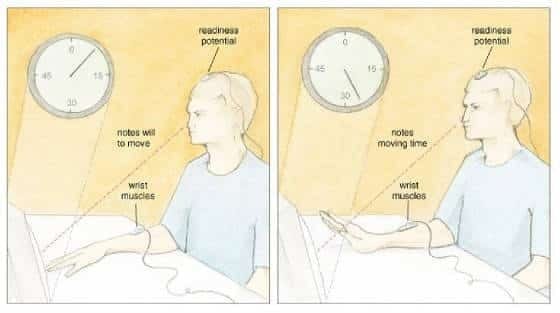

One of the more interesting sub-debates associated with Atheism vs. Religion
is that of
free will. Quite simply, many Atheists don’t believe in it at all, while the
majority of traditional believers feel that God gave them the ability to
shape their own lives by clearly making decisions for themselves.
I personally don’t believe in it. My reason for this stance is actually very
simple: I believe in nature. I believe that the world unfolds
according to the dynamics of a nearly infinite number of variables
interacting with each other. Just because there are trillions and trillions
of them doesn’t make their interactions magical (or even special).
These variables include our genetics, our experiences, what chemicals are in
our bodies at a given time, our immediate environment, etc. But ultimately,
every action that a human takes when they’re “deciding” what to do is simply
the output from one particular variable-set interaction.
Our brains are nothing but a collection of chemicals sloshing back and
forth. These chemicals interact with each other in a finite, knowable way.
The only reason we aren’t able to predict human behavior today is because we
don’t have a solid grasp of the actors involved.
This is really no different from our inability to predict the weather 100
years ago. And how did we come to be able to do so?
We simply became more capable of gathering information about the
variables.
By this point you either already agree with me or you don’t. If you don’t
then I doubt I’m going to muster up the firepower while casually writing
this post to convince you. So for the purposes of the rest of this piece
I’ll assume that you do agree with my main premise.
The Implications
What I find far more interesting than the fact that we don’t have free will
are the implications thereof. Think of what it means for society — for human
civilization as a whole. It turns out that just about everything in our
society is based solidly in the notion that we do make decisions for
ourselves.
What about our moral and legal systems? How do you punish someone for
actions they took when no choices were really made? And what does this say
about class and privilege? Doesn’t it sort of naturally lead to the
doctrines of eugenics and elitism? I think it clearly does.
And what does this say about the uniqueness of humans? We’ve all heard about
our ability to be logical and reason our way out of problems. Is this all an
illusion? Given our lack of free will, what is actually taking place when
one sits down to ponder a philosophical question or write brilliant prose?
Are we simply rocking back and forth in our little train car, trying to move
a bit farther ahead on a biological track that we can never leave? It’s as
if what we see as “discovery” and “growth” are in reality no different than
a growing snowflake. It’s beautiful to watch, and it definitely follows a
form worth giving a name to,
but ultimately the snowflake is doing precisely the only thing that it
can do, given the conditions.
The Solution
In terms of human society, the answer is actually stunningly simple:
we simply forget that we even had this discussion. Free will is, for
all intents and purposes, a necessary delusion.
To discuss the fact that it isn’t real truly serves no practical purpose
other than that of an intellectual exercise. Our civilization simply could
not advance in any positive way if this way of thinking were used to create
policy.
Normally I abhor the idea of rejecting truth in order to make life
temporarily more pleasant, but in this case I make an exception.:

 Command Your Timeline: Heal the Past, Design Your FutureIntelligence,Skills Development
  SHAPTA MOCKS 2024
 Ultimate Me: Unlock Your Ultimate Potential & Energy HealingIntelligence,Skills Development
  NLSC: SENIOR THREE AGRICULTUREAgriculture,New Lower Secondary Curriculum,Ordinary Secondary
  NLSC: SENIOR THREE CHEMISTRY
 What is ChatGPT?General
 The Changing World of Crypto: How to Stay in the Game Without Losing Faith in YourselfGeneral
 Betrayal in the City by Francis ImbugaEducation lower secondary Politics
 The Moon also sets by Osi OgbuClass Subjects
- Meet Musinguzi John Paul – Your AI Teacher of Christian Religious Education for O-Level in UgandaEducation
- Meet Mbabazi Bridget – Your AI Teacher of Entrepreneurship for O-Level in UgandaEducation
 Babirye SandraO-LEVEL ENTREPRENUERSHIP,PETTY CASHBOOK ASSIGNMENT
- Babirye SandraO-LEVEL ENTREPRENUERSHIP,PETTY CASHBOOK ASSIGNMENT
- Babirye SandraO-LEVEL ENTREPRENUERSHIP,PETTY CASHBOOK ASSIGNMENT
NLSC: SENIOR THREE AGRICULTURE
- Aheebwa JosephDP: Digital Pedagogy Assignment8
- Aheebwa JosephDP: Digital Pedagogy Assignment6
- Aheebwa JosephDP: Digital Pedagogy Assignment 3
- mukose yekosanDP: Digital Pedagogy Final Project
0 responses on "xargs vs. exec {}"