
Uganda’s STEM Opportunity: Beyond Traditional Methods
Kampala, Uganda – For Uganda to truly compete on a global stage, a dramatic shift in how Science, Technology, Engineering, and Mathematics (STEM) are taught is essential. While the importance of STEM is widely recognized, outdated teaching styles, unequal access, and limited resources are holding the nation back. This article explores innovative solutions transforming STEM education from primary school to university, focusing on practical application and future-proof skills.
Reimagining Primary STEM: From Theory to Tangible
A strong STEM foundation starts early. However, many Ugandan primary schools struggle with limited resources and a lack of specialized STEM teachers. One promising approach involves shifting from abstract theories to tangible, locally relevant examples. Imagine students learning about physics by designing and building miniature versions of traditional Ugandan cooking stoves, or understanding geometry through the patterns in local basket weaving. This contextualized approach makes STEM concepts relatable and easier to grasp.
Crucially, teacher training is being revolutionized to equip educators with the skills to deliver engaging STEM instruction. Instead of lectures, teachers are participating in hands-on workshops, learning how to use readily available materials for experiments and fostering inquiry-based learning. This sparks a passion for STEM in students from a young age.
Secondary STEM: Bridging the Gap Between Knowledge and Application
The transition to secondary school presents challenges. Students face more complex concepts, demanding a deeper understanding. However, many schools still rely on rote memorization, hindering students’ ability to apply their knowledge. Consider a student who can recite physics formulas but struggles to troubleshoot a simple electrical circuit – this highlights the need for a more practical approach.

Harnessing Technology for Immersive Learning
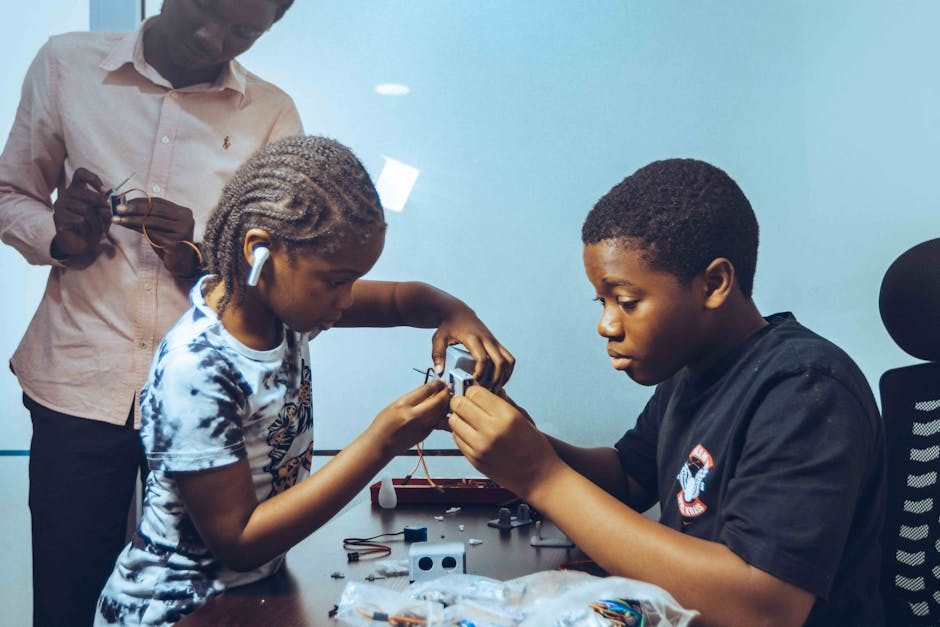
Technology is key to enhancing secondary STEM education. Instead of simply reading about chemical reactions, students can use interactive simulations to visualize them in a virtual lab. Online resources can provide access to a wealth of information and learning materials. Furthermore, participation in coding clubs, robotics competitions, and science fairs fosters creativity and problem-solving skills. Picture a team of students designing and building a robot to solve a real-world agricultural problem – this is the kind of hands-on learning that ignites innovation.
Curriculum Transformation: Focusing on Skills, Not Just Facts
A relevant curriculum is vital. It should emphasize critical thinking, collaboration, and problem-solving, not just memorizing facts. Assessment methods must also evolve. Instead of relying solely on traditional exams, project-based assessments should evaluate students’ ability to apply their knowledge to real-world challenges. For example, students could be tasked with designing a sustainable water filtration system for their community, demonstrating their understanding of science and engineering principles.
STEM in Higher Education: Fueling Research and Innovation
Ugandan universities are crucial for producing skilled STEM professionals and driving innovation. However, they often face challenges related to funding and infrastructure. Stronger partnerships between universities and industry are essential to align research with the needs of the private sector and facilitate technology transfer. For example, a university could partner with a local manufacturing company to develop new, more efficient production processes.
Investing in Research and Talent
Investing in research infrastructure, providing research grants, and fostering collaboration among researchers are essential. Universities should also encourage students to pursue research careers through scholarships and mentorship programs. Imagine a Ugandan student discovering a new, sustainable energy source – this is the potential that can be unlocked by nurturing a culture of research and innovation.

Empowering Women in STEM
Addressing gender disparities is vital. Targeted interventions, like scholarships and mentorship programs, can encourage more girls to pursue STEM careers. Creating a supportive learning environment is also crucial. For instance, showcasing successful female Ugandan scientists as role models can inspire young girls to pursue their passions and overcome societal barriers.
Conclusion: A Collaborative Vision for Uganda’s STEM Future
Transforming STEM education requires a collaborative effort. By investing in teacher training, curriculum reform, technology integration, and research infrastructure, Uganda can empower its citizens with the skills to drive economic growth. A renewed focus on hands-on learning and real-world applications will ensure that STEM education is relevant and impactful for all Ugandan students, paving the way for a brighter, more innovative future.
If you want a practical next step, you can also check out Heal your past, design your future.
If you want a practical next step, you can also check out Become an Ultimate Master of your life.


 ADVANCED LEVEL BIOLOGY, NEW CURRICULUM, SENIOR FIVEAdvanced Secondary,Biology
  Command Your Timeline: Heal the Past, Design Your FutureIntelligence,Skills Development
  SHAPTA MOCKS 2024
 Ultimate Me: Unlock Your Ultimate Potential & Energy HealingIntelligence,Skills Development
  NLSC: SENIOR THREE AGRICULTUREAgriculture,New Lower Secondary Curriculum,Ordinary Secondary
 What is ChatGPT?General
 Turmeric: The Golden Herb That Heals From the Inside OutGeneral
 Turmeric: The Golden Herb That Heals From the Inside OutGeneral
 Are You a Time Optimist? What Uganda’s Learners Must KnowGeneral
 Kyle Cease: Stop the Egoic War and Let the World Show You MoreGeneral
 How to Pass UCE Biology in Uganda: Top Strategies That WorkGeneral
 How to Pass UCE Chemistry in Uganda: Top Strategies for 2025General
 Uganda Education: How Mindset Shapes Student Success in 2026General
 Uganda Education: How to Excel in PLE, UCE & UACE ExamsGeneral
 Uganda Education & International Aid 2026: What’s Really ChangingGeneral
 Where Luxury Watches Still Offer Real Value in 2024General
 KAKURU BENARDSample Activity of Integration on Forests, Forest resources and Forestry in Africa
- KAKURU BENARDSample Activity of Integration on Trade within and outside East Africa
 Babirye SandraO-LEVEL ENTREPRENUERSHIP,PETTY CASHBOOK ASSIGNMENT
- Babirye SandraO-LEVEL ENTREPRENUERSHIP,PETTY CASHBOOK ASSIGNMENT
- Babirye SandraO-LEVEL ENTREPRENUERSHIP,PETTY CASHBOOK ASSIGNMENT

0 responses on "Bridging the Gap: Innovative Approaches to STEM Education in Uganda"